

Hebrews 10:37 LSV “For yet [in] a very, very little [while], He who is coming will come, and will not linger,”
Have you ever been reading the Bible and wondered, if God promises to return soon, why has he waited over 2,000 years? You may have asked this to a church member and received the reply, God sees time differently than us, one day with God is like a thousand years of our time (2 Peter 3:8).
Maybe the conversation ends there, or maybe you dare to ask the next question. Why does God tell us something is soon if he knows it will be thousands of years in our time? Is he not aware of time in our realm?
It seems we are stuck deciding between two obstacles. On the one hand, we believe God doesn’t come back soon and on the other he seems to say he will return soon. In this tension, we find the least offending compromise, usually the conclusion that we misunderstand the timing.
But history might provide a better answer. Most of us are unaware of the remarkable history surrounding the fall of the temple in 70AD. Almost 40 years after Jesus promises to return soon, angelic armies with flaming chariots are seen coming on the clouds against Jerusalem in 66AD before the destruction of the temple.
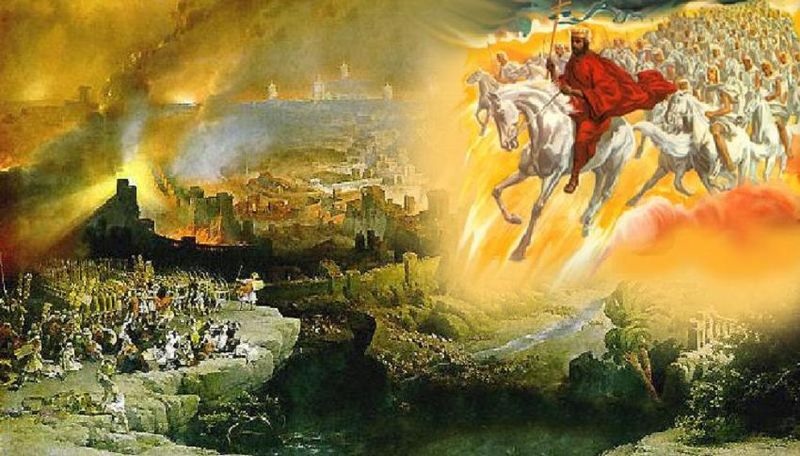
Sepher Yosippon
A Mediaeval History of Ancient Israel translated from the Hebrew by Steven B. Bowman – Chapter 87 “Burning of the Temple”
“Moreover, in those days were seen chariots of fire and horsemen, a great force flying across the sky near to the ground coming against Jerusalem and all the land of Judah, all of them horses of fire and riders of fire.”
This sounds like a fulfillment of Paul’s prophetic word to the Thessalonians.
2 Thessalonians 1:6-7 NASB 1977 “It is only just for God to repay with affliction those who afflict you, and to give relief to you who are afflicted and to us as well when the Lord Jesus shall be revealed from heaven with His mighty angels in flaming fire.”
Some of the most reliable and authentic early historians describe this event similarly including Jewish general and historian Josephus, Roman senator and historian Tacitus, the unknown Pseudo-Hegesippus, early church father Eusebius, and the anonymous Sepher Yosippon. And this remarkable event is not alone, a resurrection of the dead, events that seem like they come off the pages of Revelation, and other stunning but documented events happen around this time raising questions that a first-century fulfillment of Jesus’s words may be possible.
If this history is true, it seems to prove that Jesus did return soon as he promised. Unfortunately, we are taught most of our lives that Jesus is about to come in our future and rid the world of all evil. We find meaning, purpose, and hope in this promise and questioning these beliefs may feel humbling and earth-shattering. Although questioning a major doctrine of the church can seem an impossible task, many brave Christians take this journey and find more peace, faith, hope, relief, excitement, and purpose than is possible from the land of dissonance they leave from.
Questioning major church doctrines is not something to take lightly but I think we are grateful that Martin Luther didn’t falter on teaching justification by faith just because the Catholic Church didn’t agree. From time to time, we do find errors in our fundamental doctrines that need to be corrected and it takes honest, brave, well-studied, and faith-filled individuals to find the truth and share it.
If you’re willing to take the first step, I want to reply to that friend at church who told you that God sees time differently than we do.
Does God use soon the way we do?
Throughout the Bible, the language “about to” and “soon” describe events that are genuinely near in human terms (Acts 11:28, Acts 25:1-6, Acts 27:10, Acts 28:6, etc…).
Acts 28:6 NASB 1977 But they were expecting that he was about to swell up or suddenly fall down dead. But after they had waited a long time and had seen nothing unusual happen to him, they changed their minds and began to say that he was a god.
If the disciples use soon the way we imagine, does God use time statements this way?
God tells Daniel that the vision given him concerns the “distant future” (Daniel 8:26 NIV). (You can compare this passage to Revelation 22:10). In God’s perspective, does this mean the vision is many thousands of years in the future? Not quite. God tells Daniel the vision will come to pass in 490 years (Daniel 9:21-27). God doesn’t even consider 490 years soon.
God promises a near destruction of Jerusalem by the Babylonians using the terms “has come”, “is near”, “soon”, or “about to” (Ezekiel 7:6-8). Israel claims this threat concerns the distant future and isn’t near. God rebukes them for not paying attention to the timing of this prophetic word.
Ezekiel 12:21-28 ESV And the word of the Lord came to me: 22 “Son of man, what is this proverb that you have about the land of Israel, saying, ‘The days grow long, and every vision comes to nothing’? 23 Tell them therefore, ‘Thus says the Lord God: I will put an end to this proverb, and they shall no more use it as a proverb in Israel.’ But say to them, The days are near, and the fulfillment of every vision. 24 For there shall be no more any false vision or flattering divination within the house of Israel. 25 For I am the Lord; I will speak the word that I will speak, and it will be performed. It will no longer be delayed, but in your days, O rebellious house, I will speak the word and perform it, declares the Lord God.”
26 And the word of the Lord came to me: 27 “Son of man, behold, they of the house of Israel say, ‘The vision that he sees is for many days from now, and he prophesies of times far off.’ 28 Therefore say to them, Thus says the Lord God: None of my words will be delayed any longer, but the word that I speak will be performed, declares the Lord God.”
The destruction of Jerusalem occurs a few years afterward (Ezekiel 33:21). If God rebukes Israel for thinking that something He promises soon is far off then God knows how to communicate time in our terms and expects us to take him seriously when he does so.
The question now becomes does Jesus promise to return soon?